

When the growth of traditional industries slows, can fast-forwards become the second curve?
Bloomage Biotechnology is the leader in the "appearance economy" and one of the largest hyaluronic acid suppliers in the world. However, after years of rapid development, the field of light medical beauty has gradually become saturated, the company's performance growth has gradually become weak, and the stock price has fallen. However, relying on its production advantages in core resources, the company has begun to enter the general food industry, hoping to meet the current consumers' needs for beauty and health through a richer product matrix, thereby finding the "second curve." Against this background, the company takes drinking water as the direction of new product development and has prepared several product formulas and conceptual solutions. It needs to screen out the best solutions through research and gain insight into the selling points and shortcomings of new products, thereby reducing the risk of new product exploration.
01 Technically, screen for popular taste programmes through quantitative tests + qualitative interviews
In the quantitative research stage, we designed two rounds of tests, namely a one-way cyclic blind test (consumers tasted three products and two competing products in random order) and a paired blind test (compared two products and two competing products in pairs). The purpose was to allow subjects to fully experience the taste differences between different products.
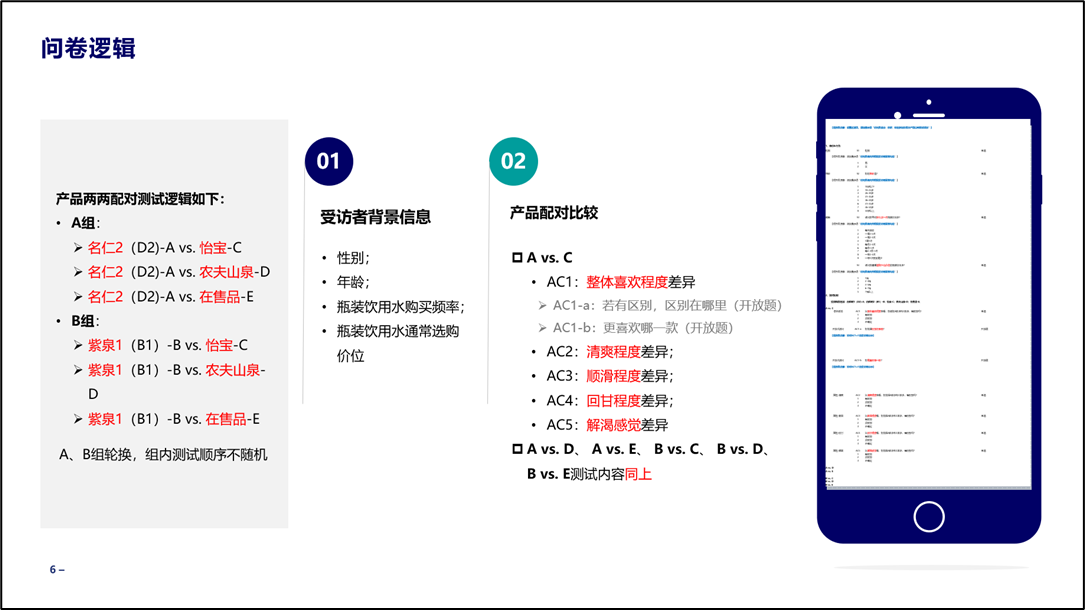
(product single blind test logic)
After the quantitative test, we designed a structured interview session to understand the subjects’ views on the advantages and disadvantages of each product taste, as well as their bottled water usage scenarios and purchase decision-making logic.
Through these research tools, we have helped branders to screen for relatively competitive tastes and provide important references for future product optimization by branders.
02 However, drinking water is a monopolistic competitive market, and the two giants have gained a major market share, and taste is not a major consumer concern.
For consumers, packaged drinking water is first and foremost a category concept. Whether it is daily life or sports replenishment, the first thing consumers think of is "drinking water" rather than drinking a certain brand of water. In fact, the taste test results also show that the proportion of consumers who can accurately name the brand of the product is not high. For example, ordinary consumers have difficulty distinguishing the taste difference between Coca-Cola and Pepsi-Cola.
If taste is difficult to become a means for new brands to open up consumer minds, is there any other way? The answer is simple, and that's marketing.
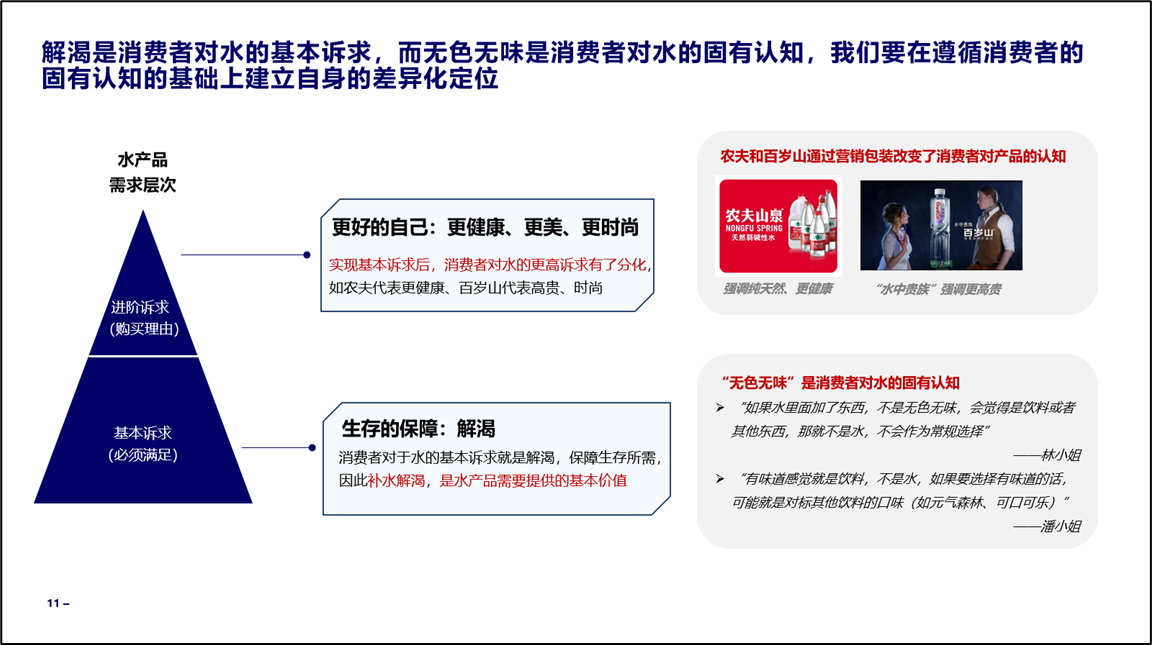
(Insight of consumers through product tests)
In fact, it is not uncommon to build the minds of brand users through marketing communications. Typical cases include Nongfu Spring's "a little sweet" communication, Melatonin's "only accept Melatonin for gifts", and Mioclando's "cheese, just choose Mioclando". We can see that successful FMCG marketing communication cases have a characteristic, that is, the brand strives to link or even equate its products with the category, in order to expand market share.
"Light medical beauty" is a narrative that Bloomage Biotech has the right to speak. This is a core competitiveness that other mainstream brands do not possess. Therefore, in the marketing packaging of drinking water products, we should make full use of this advantage, establish a differentiated marketing communication strategy, and strive to make drinking water a new business growth point.
