

Global and domestic market share and ranking of wind lubricating systems
The case shows the process of studying market size, competition patterns, market shares and rankings after a clear class, region and statistical calibration.
Section I. Overview of developments in the wind lubricants industry
System composition and central role
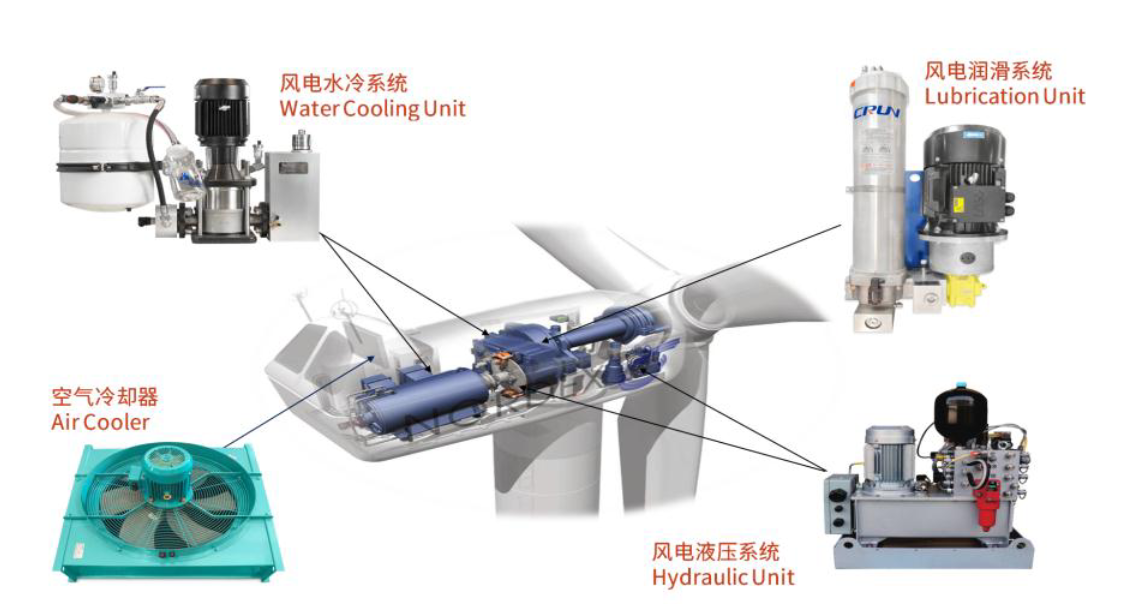
The wind power hydraulic lubrication fluid control system includes three major systems: lubrication, hydraulic pressure, and cooling. Among them, the lubrication system provides lubrication and cooling for key components such as wind turbine gearboxes to ensure the normal operation of friction parts such as gears and bearings; the hydraulic system provides power for pitch, yaw and other devices; the cooling system is responsible for heat dissipation of generators, frequency converters and other equipment.
Figure 1
Source: Guangcai Securities Research.
Customize the demand background
Wind turbines have harsh working conditions (high loads, complex environments), precise structures, and inconvenient maintenance. Traditional lubrication methods cannot meet the needs, so customized centralized lubrication systems have emerged. This system can avoid failures caused by improper lubrication and improve the stability, efficiency and service life of wind turbines. It is mainly used in core systems such as main shaft, yaw, pitch, and generator.
Cost-to-cost characteristics
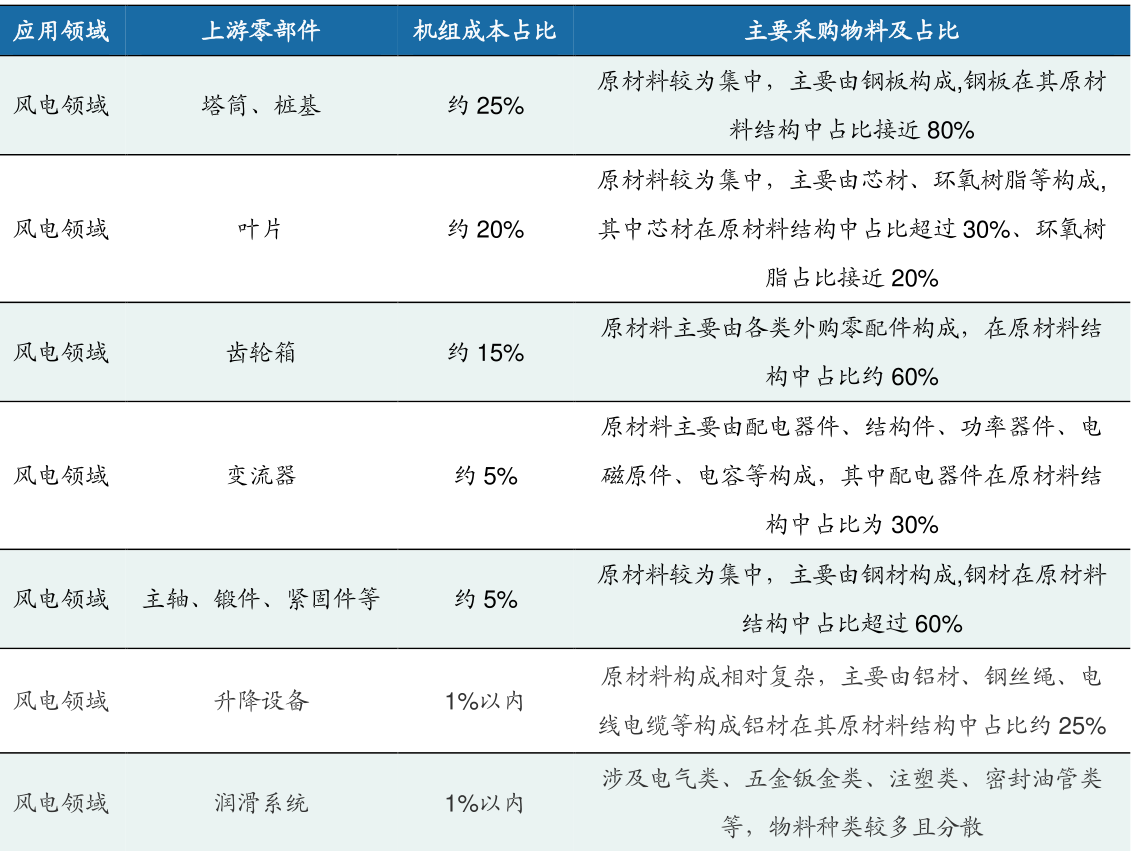
Lubrication systems account for less than 1% of the cost of wind turbines, but the product structure and material composition are complex (involving electrical, hardware, injection molding and other types of materials) and are less affected by fluctuations in raw material prices. Complete wind turbine manufacturers have low price sensitivity, and with a non-cost-plus pricing model, the industry's gross profit margin is relatively high.
Figure 2
Source: Acronyms, Centre for the Study of Widely Issued Securities.
Section II. Background to the development of the wind lubricants industry
Policy-driven wind and electricity sector growth
The national “two-carbon” goal has been driven by a number of policies to accelerate the high-quality development of the wind and electricity sector:
- In 2024, the "Guiding Opinions on Energy Work in 2024" requires that wind power and solar power generation account for more than 17%, and the construction of large-scale wind power photovoltaic bases and offshore wind power will be promoted;
- The Action Programme for Energy Conservation and Carbon Reduction 2024-2025 provides for the acceleration of the development of wind power bases and marine wind power clusters in the Shago desert;
- The Large-scale Equipment Upgrading Implementation Programme in the energy focal area encourages the upgrading of wind farms and the promotion of efficient smart units;
- The 2025 policy further explicitly advances projects such as the Shago Desert base, wind at sea and the integration of photovoltaic and wind.
These policies support the expansion of the wind and electricity sector and the growth in demand for indirect wind and lubricants.
Section III. Current developments in the wind lubricants industry
Core system functions and industrial chain
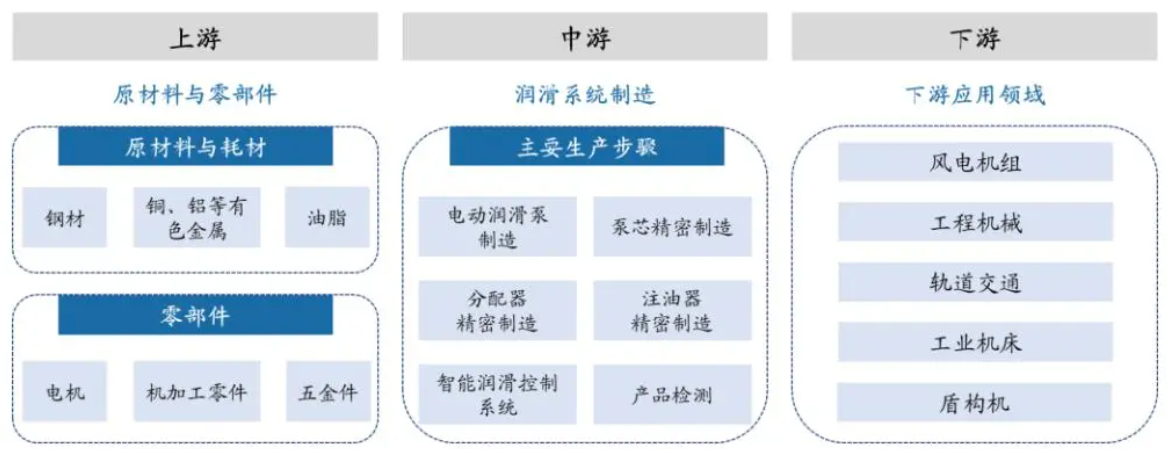
The lubrication system has multiple functions such as lubrication, cleaning, cooling, and sealing, and is widely used in wind power, engineering machinery, rail transit and other fields. Its industrial chain is clear: the upstream is raw materials such as steel, non-ferrous metals, grease, and parts such as pumps and distributors; the midstream is system manufacturing (including precision processing, testing, etc.); the downstream is mainly for wind turbines, engineering machinery and other application scenarios.
Figure 3
Source: Acronyms, Centre for the Study of Widely Issued Securities
Global growth in wind and electricity in China
- Global: 117GW of newly installed wind power capacity will be added in 2023 (+50% year-on-year), a record high; offshore wind power installed capacity will be 10.8GW, a significant growth rate, and it is expected that the newly installed capacity will reach 66GW in 2033, with a compound annual growth rate of 20%.
- China: Wind power installed capacity continues to expand. In 2024, the newly installed capacity will be 79.82 million kilowatts (+6% year-on-year), and the cumulative grid-connected capacity will reach 521 million kilowatts. The trend of large-scale units is obvious. From 2022 to 2023, the single unit capacity of land wind and sea wind will increase by 37.9%, 33.4%, 25.1%, and 29.4% respectively.
Market size and application distribution
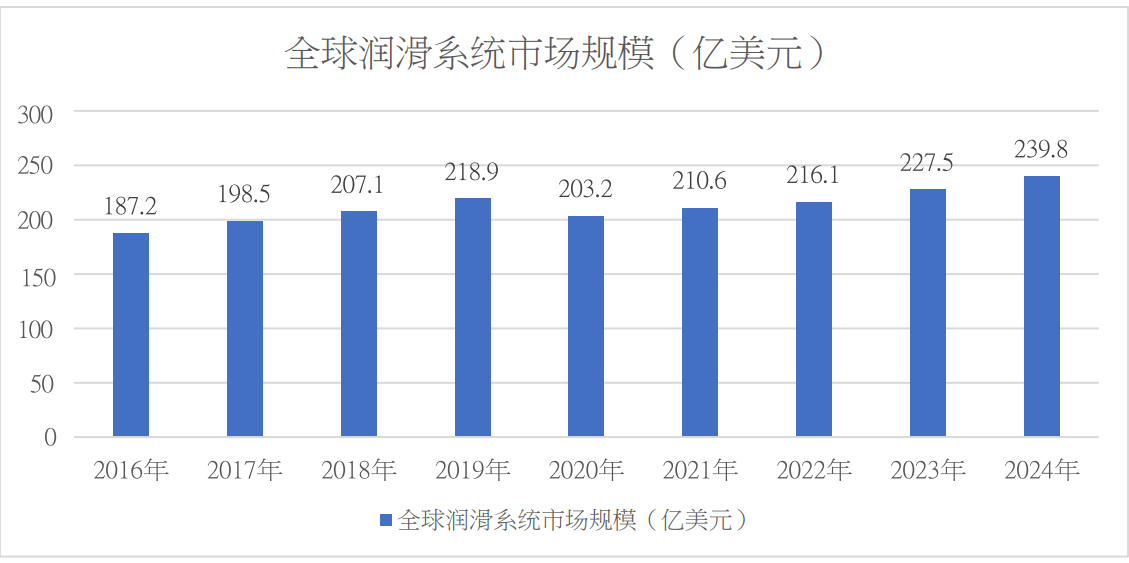
- Market size: The global lubrication system market size is rising steadily, reaching approximately US$23.98 billion in 2024 (+5.4% year-on-year); the Chinese market will reach 47.43 billion yuan in 2024 (+5.6% year-on-year).
- Application fields: Data in 2021 show that lubrication system applications are mainly in automobiles (38.4%), metallurgical mining (23.1%), and power equipment (18.3%). Wind power is the core application scenario in the field of power equipment.
Figure 4 Global lubrication system market size
Source: SWAN, Centre for the Study of Broader Securities, Mindwise Consulting Research Department
Figure 5 Market size of China’s lubrication system
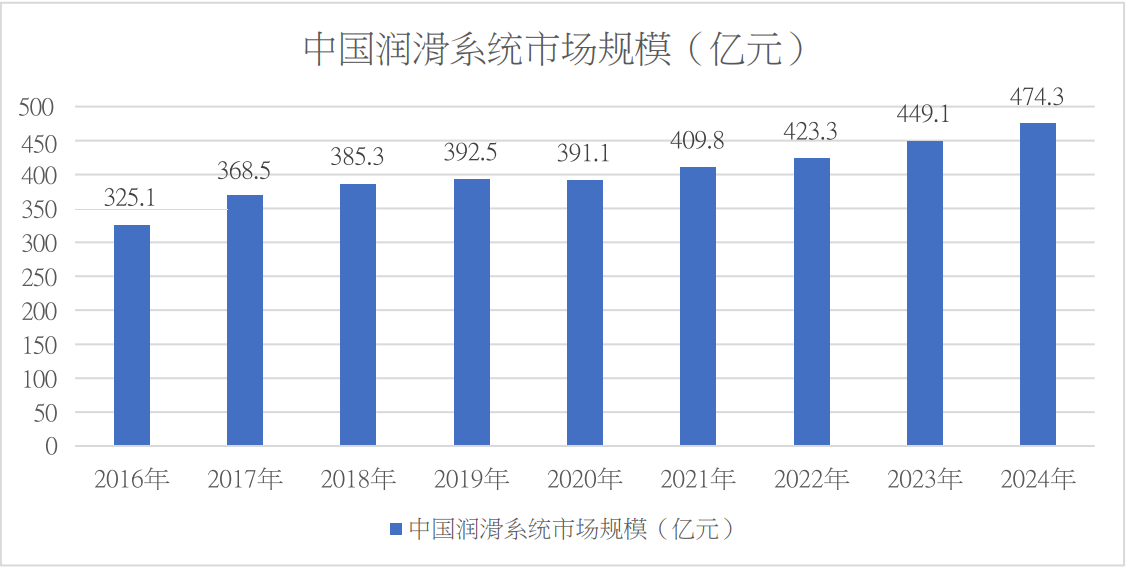
Source: SWAN, Centre for the Study of Broader Securities, Mindwise Consulting Research Department
Centralized lubrication system dominance
The centralized lubrication system is currently the most widely used type (including throttling type, single-line type, etc.). It consists of a lubrication pump, distributor, pipeline and control system. It can meet the high-precision lubrication needs of key components such as fan bearings and gears and reduce friction losses. It is the mainstream technology direction of the industry.
